Making Energy Visible
Clean Energy Hub
Overview
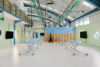
The Clean Energy Hub at the Gordon TAFE East Geelong Campus is a purpose-designed learning environment that supports the next generation of renewable energy professionals. Created for secondary school students, the facility provides hands-on education in renewable energy technologies, with a focus on energy storage, smart grids and circular economy principles, helping equip students with the skills required for Australia's transition to a low-carbon future.
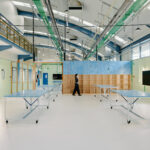
Rather than constructing a new facility, the project demonstrates the value of adaptive reuse by transforming an underutilised workshop into a contemporary, flexible learning environment. Existing lightweight partitions and redundant extraction infrastructure were removed and replaced with a large sliding partition, creating two adaptable teaching spaces that can operate independently or combine for larger demonstrations and collaborative learning.
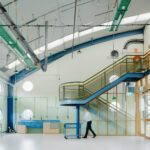
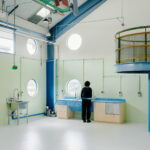
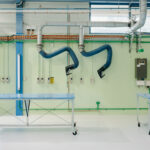
A key design driver was to maximise the use and visibility of recycled and reclaimed materials throughout the fit-out. Developed in close collaboration with Gordon TAFE and the Geelong Tech School, the design makes sustainability visible rather than concealed. Renewable energy technologies and sustainable materials are highlighted and become part of the educational experience, allowing students to engage directly with the systems and principles they are studying. The architecture itself acts as a teaching tool, reinforcing the connection between design, technology and environmental responsibility.
Flexibility underpins the project's long-term sustainability. Adaptable teaching spaces support a wide range of learning modes and future pedagogies, extending the useful life of the facility while reducing the need for future alterations.
Clear wayfinding, universal accessibility and an inclusive spatial layout ensure the hub is welcoming, legible and accessible to all users, creating an environment where sustainable education is both engaging and equitable.
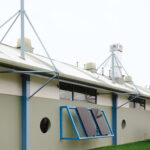
To support hands-on learning, two additional solar panels are mounted on the external facade, allowing students to directly engage with and observe the technology.
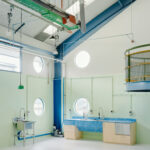
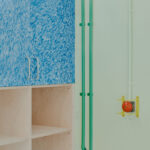
By making the building's infrastructure visible, the project transforms the services into an educational tool, helping students understand how renewable energy is generated, stored and distributed.
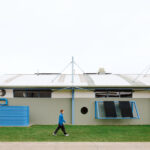
To support hands-on learning, two additional solar panels are mounted on the external facade, allowing students to directly engage with and observe the technology.
By making the building's infrastructure visible, the project transforms the services into an educational tool, helping students understand how renewable energy is generated, stored and distributed.